Physiotherapy Department
Information for Patients
Introduction
Being physically active is good for your heart, body, and mind, and is particularly important for people having peritoneal dialysis (PD). When your kidneys are not working at their best, waste products that they would normally remove can build up. This can affect your muscles, making you feel weaker. You can also develop a low red blood count (anaemia), which can make you feel tired and breathless. Weakness and tiredness can make it more difficult to do everyday activities.
In addition to PD, you may also be living with other health conditions, and have other family, work or social responsibilities which take up your time and energy. If you are also feeling weak and tired, it can be difficult to manage all of these. In these circumstances, it is very common to avoid activities that feel challenging, but this may not help.
Have a look at the diagram below and see if it looks familiar to you.
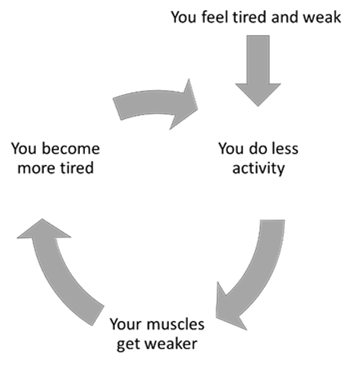
Being physically active, including exercising, can help you get out of this cycle and back to doing the things that matter to you. The specific benefits of physical activity and exercise for people having PD are:
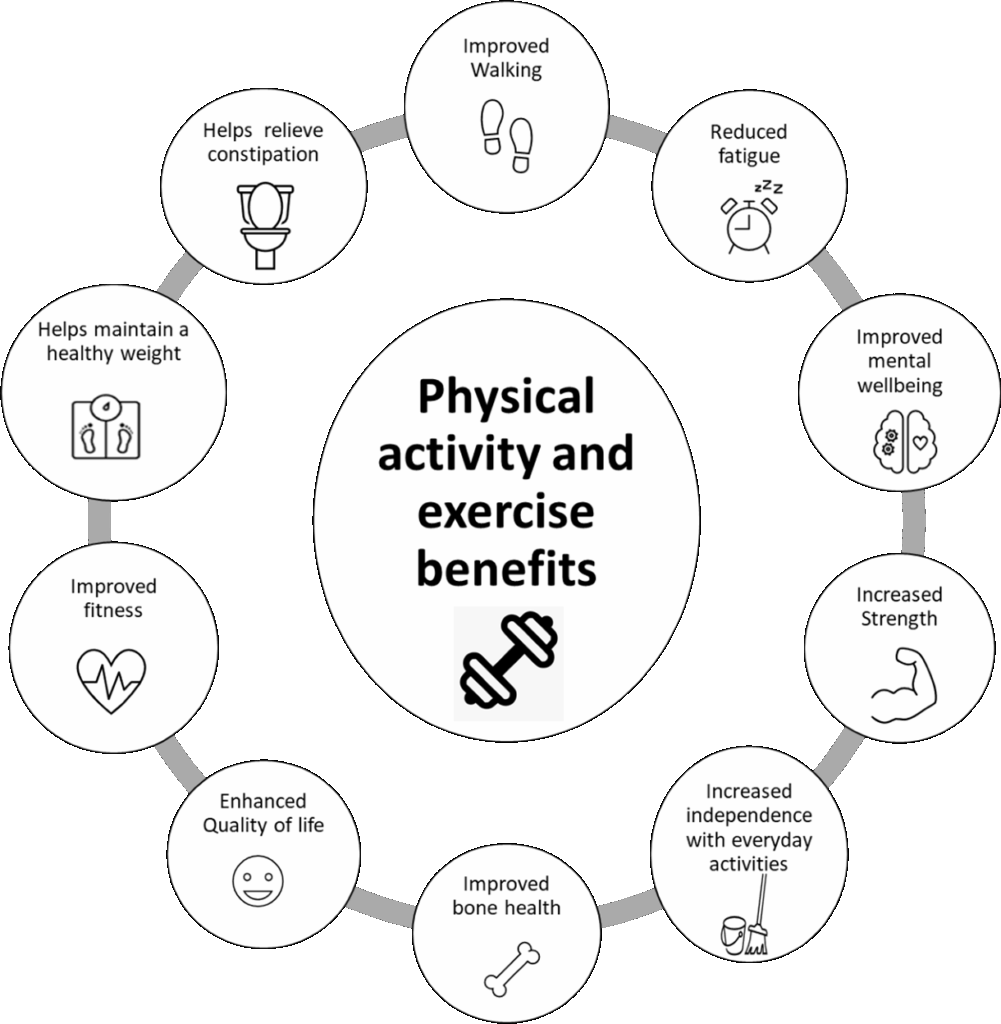
Regular exercise can also help to prevent you developing conditions such as heart disease or type 2 diabetes. If you are already living with other long-term conditions, becoming physically active is an important part of managing these.
The aim of this booklet is to increase your confidence to exercise. Make sure you read the booklet fully before you start.
Before starting exercise
Talk to your GP or kidney doctor first if you:
- have a history of heart problems.
- get chest pain or feel dizzy when exercising.
- have diabetes.
- are considering more strenuous physical activity, such as running or heavy weightlifting.
Exercises to try at home
There are different types of exercise, with different benefits. Before you start any type of exercise it is important to warm up for 5 minutes. Warming up slowly raises your heart rate and body temperature and helps to prevent injuries. When you have finished exercising, ‘cooling down’ will help to return your breathing and heart rate back to their usual level. A mix of gentle walking (or marching on the spot) and stretches (see later in the booklet) is an effective warm-up and cool down. Start with 1 minute of walking, then 1 minute of stretching, until you have completed 5 minutes.
Aerobic exercise
Any activity which makes your heart beat faster and you breathe a bit deeper is aerobic exercise (e.g. walking, cycling, and swimming). This type of exercise can help to increase how fast and for how long you can keep going (endurance). The NHS recommends you aim to be active for 30 minutes on most days of the week, and more is better.
It can be challenging to do this right away so start and progress slowly over time. There is no need to do 30 minutes all in one go. You can do smaller chunks of activity through the day. Commitment is needed to see the benefits so keep going and be patient! As you become fitter, try, and go for longer each time until you can do 30 minutes in one go. The more you can do in one go, the greater the benefits.
How do I know how intense the exercise is?
To get the most from your exercise programme you want to try and achieve a level which is ‘moderately intense’. Using a simple scale can help you to rate how hard you are working. Whilst you are exercising, or just afterwards, think about how much effort it was. Effort is felt as breathlessness, tiredness, and muscle soreness, all of which are normal when exercising. Be as honest as possible, it is important that it is your own feeling of effort and not what others think. Base your rating on the words, but then choose a number. Use whichever numbers you want on the scale.

Walking
Walking is one of the simplest forms of aerobic exercise. If you are not used to regular walking begin by timing what you can do, then add a couple of minutes on each day. A brisk walk will help you get to a moderate intensity. Use the guide above to help you decide what moderate intensity is for you.
Remember to:
- Wear sturdy footwear
- Walk on well-lit routes
- Monitoring your blood sugar and go for a walk when it is most stable if you have diabetes. You may also want to take a sugary food with you
- Carry a mobile phone
- Tell somebody where you are going and what time you expect to be back
Take care if your medications have recently been changed. This can affect how you feel when you exercise. If you are someone who has a history of falls, brisk walking may not be the right kind of aerobic exercise for you – walking at your usual pace still has health benefits. Speak to your healthcare team.
Weight bearing exercise is important for bone health. This involves being on your feet and adding an additional force or jolt through your skeleton. Exercises such as swimming and cycling are non-weight-bearing low impact aerobic exercises, so if you choose these, remember to also include some weight-bearing exercise such as walking.
Try to limit the time you spend sitting or lying down. If you use a wheelchair or have very restricted walking, speak to your healthcare team for advice on other exercises and activities to suit your needs.
Swimming and other water sports
There are several steps you can take to make sure your swim is safe and enjoyable. If the area where your PD tube comes out of your tummy (the exit site) has not healed, or it is infected, do not swim until it has healed. Swimming in clean pools or sea water will reduce the risk of infection. Before swimming, or any water sports, cover your catheter and exit site with an activity pouch. Perform routine exit-site care after swimming. Avoid diving as this can put tension on your PD catheter.
Strengthening exercises
Strengthening exercise, (also called resistance exercise) is exercise that make you stronger and usually involves using a weight or your own body weight. These types of exercises can help you do your usual activities more efficiently and easily.
What can I use as weights and how do I choose the right weight?
You can buy a set of dumbbells or resistance bands from a sports shop, but you do not need any special equipment. Plastic milk containers filled with water work well as weights or you can use tins of baked beans or anything else that feels safe to hold. Below is a guide to the weight of different sizes of milk containers as a guide.
| Milk container size | Weight |
| 1 pint | 0.6kg (1lb 5oz) |
Arm, chest, and upper back exercises
These exercises will improve your ability to do activities such as carrying the shopping and picking things up.
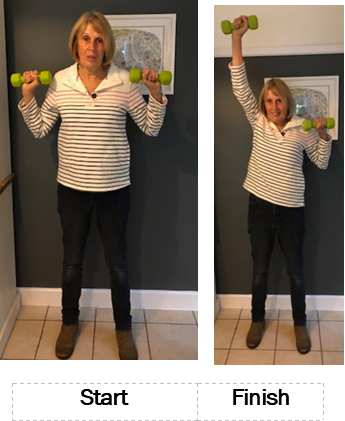
Alternate shoulder press
- Standing, or sitting in a hard backed chair, with a straight back, looking forwards, with feet should width apart and flat on the floor.
- Hold your weights with palms facing forwards at shoulder height.
- Slowly push 1 weight upwards until your arm is straight and above your shoulders.
- Return to the starting position.
- Repeat with the other arm.